Homeowner guide
A plain-English walkthrough of what hail actually does to an Ozarks roof, what an insurance adjuster counts as damage, and what does not qualify — written by the people who climb it.
Hail does not hit a roof in isolation. Before anyone goes up a ladder, we walk the house, because the soft metal on the ground floor tells the story of the storm.
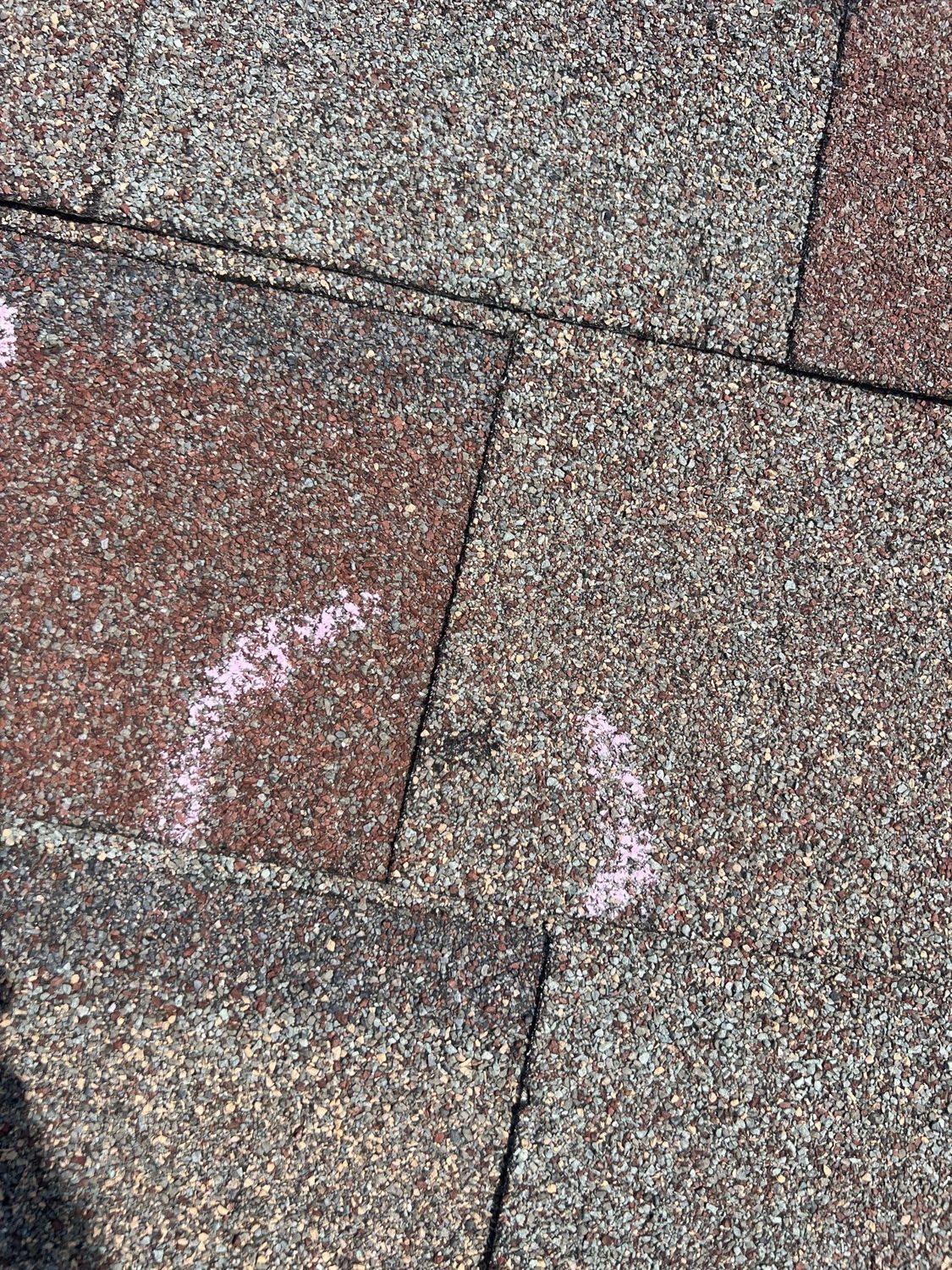
An adjuster does not walk the roof looking for a general impression. They mark off test squares — usually ten feet by ten feet on each slope — and count qualifying hits inside them. If enough slopes carry enough hits, the carrier pays for replacement. If they do not, it is a repair, or nothing.
Half the roofs we inspect after a storm do not have a claim. We would rather tell you that than sell you a roof you did not need. Jeremy, Nixa Roof Co
Carriers deny claims over exactly these, so it matters that whoever documents your roof knows the difference and does not argue for damage that is not there.
On most asphalt shingle roofs in the Ozarks, functional damage starts showing up around one inch and gets consistent above an inch and a quarter, but size alone is not the whole story. Wind speed and direction, the angle of the slope, shingle age, and how brittle the mat has gotten all change the outcome. We have seen quarter-size hail bruise a fifteen-year-old roof and golf-ball hail barely mark a two-year-old one.
Random — not patterned — dark impact marks where the granules have been knocked off, often with a bruise you can feel with your thumb before you can see it. Fresh hits look clean and shiny. Along with the shingles we look at soft metal: gutters, downspouts, drip edge, vents, flashing, valleys, and window wraps. Dents in soft metal are how you date a storm, because they do not heal or weather away like granule loss does.
Check from the ground first, and please stay off a wet or steep roof. Look at the gutters and downspouts for dents, look for a pile of granules where the downspouts drain, look at the AC condenser fins, and look at any painted metal on the house. If those show hits, the roof almost certainly took hits too. That is the point to have someone go up who is insured to be up there.
Your policy sets the deadline, not the state, and most Missouri homeowner policies expect prompt notice — commonly within one year of the date of loss, sometimes two. The practical problem is not the deadline, it is proof: the longer you wait, the easier it is for a carrier to argue the damage came from a different storm or from wear. If you think a specific storm hit you, get it documented now even if you have not decided to file.
Free inspection, honest scope, and a written estimate you can hand to your insurance company. No pressure, no sales theater.